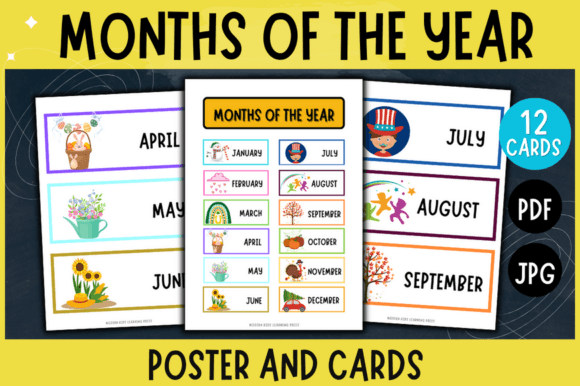
Months of the Year Poster: A Creative's Guide
In the world of visual communication, time is a narrative device. Whether you are designing a planner, creating a classroom aid, or building a brand identity for a stationery line, how you represent the twelve months of the year sets the entire tone. The Months of the Year Poster is not merely a calendar; it is a design asset that bridges the gap between educational utility and aesthetic appeal. Much like the "Alphabet Animals Dot Markers Worksheets," which turn learning into an interactive, tactile experience, a well-designed poster transforms the abstract concept of time into a visual journey that engages the viewer.
For designers, marketers, and educators, the challenge lies in finding resources that serve a practical purpose without sacrificing style. A generic list of months might get the job done, but it won't capture attention. The Months of the Year Poster concept focuses on modern typography and layout design to ensure that the information is accessible, memorable, and visually striking. It is a tool that respects the viewer's intelligence while delighting their senses.
The Anatomy of Visual Timekeeping
When we analyze the Months of the Year Poster, we are looking at more than just letters on a page. We are examining the hierarchy of information. In editorial design and web design, hierarchy dictates the user journey. A successful poster uses a mix of typefaces—perhaps a bold display font for the month names paired with a clean sans serif font for supplementary details—to guide the eye naturally from January to December.
The personality of the poster depends heavily on the chosen typeface. If the design utilizes a serif font, the result often feels traditional, trustworthy, and academic, suitable for vintage-inspired branding or formal packaging design. Conversely, a handwritten font or script font introduces warmth, whimsy, and a human touch, making it ideal for lifestyle blogs, wedding invitations, or boutique branding. The Months of the Year Poster acts as a canvas where these font pairing decisions play out in real-time, allowing you to test how different weights and styles interact within a confined space.
Furthermore, the visual characteristics of the poster—its spacing, alignment, and color palette—contribute to its overall appeal. A minimalist layout with ample whitespace projects sophistication, while a colorful, illustrated approach (similar to the engaging Alphabet Animals Dot Markers Worksheets) fosters creativity and energy. This flexibility makes the poster a versatile component of any designer's toolkit.
Strategic Applications for Professionals
How does a Months of the Year Poster fit into the workflow of a small business owner or a content creator? The applications are broader than one might initially think.
- Brand Identity and Consistency: For businesses that rely on seasonal marketing, a custom poster serves as a central piece of brand identity. It ensures that all visual materials, from social media graphics to email newsletters, align with a cohesive aesthetic. Using the same premium font across your poster and your logo design solidifies brand recognition.
- Print and Digital Media: Whether you are publishing a physical magazine or curating a digital portfolio, the typography used in the poster sets the mood. A creative font can turn a simple date tracker into a piece of art worthy of framing, while a more functional sans serif font ensures readability on mobile screens and tablets.
- Educational and Retail Environments: Just as the dot marker worksheets help children with fine motor skills, a poster in a classroom or retail store provides immediate context. It anchors the space in the present moment, helping customers or students navigate the flow of the year.
Evaluating and Implementing Design Assets
Choosing the right Months of the Year Poster requires a critical eye. As a creative professional, you should treat this selection process with the same rigor you would apply to choosing a commercial font.
Readability is Paramount: Regardless of how beautiful a script font might be, if the viewer cannot instantly read "September," the design fails. Test the poster at various distances. Does the visual hierarchy hold up? Are the letters distinct enough to be recognized quickly?
Testing Pairings and Styles: If you are using the poster as a template or inspiration, experiment with font pairing. Try combining a geometric sans serif font with an organic handwritten font to create contrast. This dynamic tension often results in the most engaging layouts.
Licensing and Usage: Always verify the terms of use. Many design assets are available for personal projects but require an extended license for commercial distribution. Ensure that your chosen poster or the fonts within it are cleared for your specific use case, whether it is for a client's packaging design or a downloadable product on your website.
From Concept to Creation
Ultimately, the Months of the Year Poster is a testament to the power of modern typography. It proves that even the most mundane information can be elevated through thoughtful design. By incorporating this asset into your projects, you are not just marking time; you are curating an experience. Whether you lean towards the structured elegance of a serif font or the fluid motion of a display font, the goal remains the same: to communicate clearly and connect with your audience on a visual level. Treat your timeline as a design opportunity, and watch how it transforms the perception of your brand.