Adult & Student ADHD: A Planner for Real Daily Productivity
When the To-Do List Becomes the Overwhelm
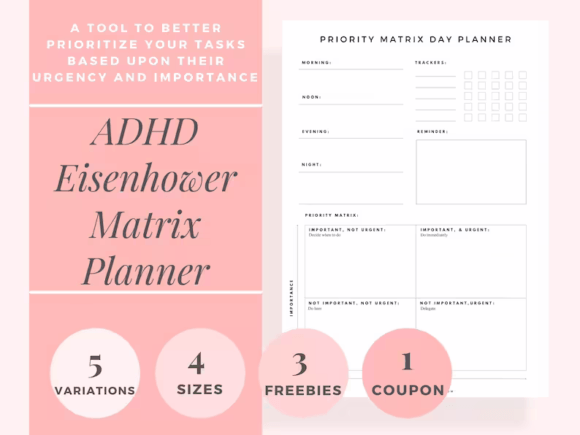
For many adults and students navigating ADHD, the simple act of planning a day can feel like the biggest hurdle. A standard, linear to-do list often becomes a source of anxiety—a mountain of tasks with no clear starting point, leading to paralysis rather than progress. This is where a specialized approach, like the Adult & Student ADHD Daily Productivity Planner, shifts the paradigm. It’s not just another notebook; it’s a structured system designed to work with the ADHD brain, not against it. The core of this system is the Eisenhower Matrix, a visual tool that transforms a chaotic list into a manageable, prioritized action plan.
The visual design of this planner is intentionally functional and calming. It avoids overwhelming patterns or complex graphics. Instead, it uses clean lines, ample white space, and a deliberate use of color coding—offered in five variations—to create a visual hierarchy that guides the eye without causing distraction. The personality is supportive and practical, aiming to reduce cognitive load. Its overall appeal lies in its ability to make the abstract concept of "getting organized" feel tangible and achievable, one quadrant at a time.
The Eisenhower Matrix: Your ADHD-Focused Brand Identity
Think of the Eisenhower Matrix not just as a planning tool, but as the foundational brand identity for your daily workflow. In brand strategy, a strong identity provides clarity, consistency, and recognition. This matrix does the same for your tasks. By categorizing activities into four clear quadrants—Urgent & Important, Important but Not Urgent, Urgent but Not Important, and Neither—it creates a visual system that instantly communicates priority. This is modern typography in action, where form directly serves function.
This system excels across multiple applications, much like a versatile premium font. For the entrepreneur or small business owner, it’s a daily business planner for managing client work, marketing, and admin. For the student, it structures study sessions, assignments, and personal time. For the creative professional—designer, blogger, or crafter—it helps separate deep, focused work (Important but Not Urgent) from reactive tasks (Urgent but Not Important). The four included sizes ensure it fits any workflow, from a desk blotter to a portable personal planner.
Practical Application: From Overload to Action
Let’s break down how this works in a real-world scenario. Imagine you’re a content creator with a list of 15 tasks: "Write blog post," "Answer urgent client email," "Research new camera," "Scroll social media for inspiration," "File invoices." Using the matrix:
- Urgent & Important (Do First): The client email with a tight deadline.
- Important but Not Urgent (Schedule): Writing the blog post (this is your high-value work).
- Urgent but Not Important (Delegate): Filing invoices—could this be automated or batched?
- Neither (Eliminate): Mindless social scrolling disguised as "research."
This process is the essence of effective personal work management. It forces a moment of critical evaluation, moving you from reactive mode to proactive planning. The simple templates included provide a clean, undistracted space to execute this, ensuring the focus remains on your priorities, not on complex planner mechanics.
Choosing Your System: Beyond the Aesthetic
Selecting a planner is a personal decision, akin to choosing a font pairing for a logo design or editorial design. It must fit your specific needs and working style. When evaluating this ADHD productivity system, consider these practical points:
- Project Fit & Readability: Does the matrix layout align with how you naturally think about tasks? Test the readability of the color variations. Some may find certain hues more calming or energizing for daily productivity.
- Integration with Your Tools: How will this physical or digital planner work with your existing digital tools? It should complement your calendar and project management apps, not duplicate them.
- The "Freebies" as Value-Adds: The three included bonus templates are like a font’s additional stylistic sets or alternates—they expand the utility of the core product. Assess if these extras (perhaps a weekly review sheet or a habit tracker) genuinely support your adult & student ADHD management.
- Licensing & Commercial Use: If you are a professional using this system to manage client projects or your business, ensure the license permits commercial use. This is a key E-E-A-T consideration—you need tools that are legally sound for your professional context.
Ultimately, the goal is consistency. Just as a strong typeface builds recognition in packaging design or web design, consistently using a planning system that reduces friction builds your capacity for sustained focus and achievement. This planner is a design asset for your mind. Its value isn’t in the paper or pixels, but in the mental clarity it fosters, helping you build a daily structure that finally feels like it fits.